




AZALEA. Watercolor, Carl Larsson, 1906.
The azalea in the foreground enhances Karin’s warm gaze as she stands at the loom. Her creativity brings life to a unique home where she designs furniture, textiles, clothing, and interiors. Karin’s imprint becomes a central part of her and Carl’s shared artistry. She weaves modernist tapestries, embroiders cushions, and creates new fashion for the family. She designs avant-garde furniture and finds practical solutions for the interior. Through motifs from the home, her ideas spread rapidly.


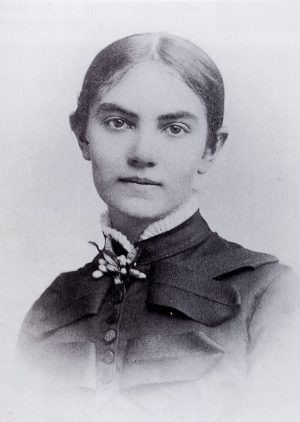
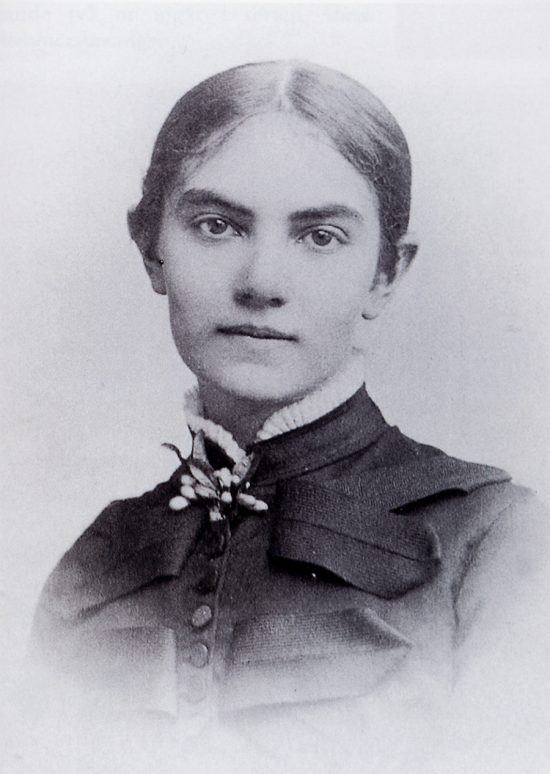
BORN: October 3, 1859, in Örebro, grew up in Hallsberg.
EDUCATION: French School, School of Industrial Arts, and the Royal Academy of Fine Arts.
FAMILY: Adolf and Hilda Bergöö. Siblings Per, married to Anna, and Stina, married to Frank Bather. Married to Carl in 1883.
CHILDREN: Suzanne 1884–1958, Ulf 1887–1905, Pontus 1888–1984, Lisbeth 1891–1979, Brita 1893–1982, Mats 1894–1895 (died two months old), Kersti 1896–1975, and Esbjörn 1900–1937.
KEY DATES: In 1882, Karin travels to the Scandinavian artists’ colony in Grez-sur-Loing, France. There she meets Carl. They marry in 1883, and their first child, Suzanne, is born in 1884. In Sundborn, Karin applies her artistic talents to the interior design of their home with innovative textiles, modern furniture, and self-designed clothing, including the famous “Karin apron.” Karin’s personal interior design style achieves its major international breakthrough with the large Carl Larsson exhibition at the Victoria & Albert Museum in London in 1997.
DIED: February 17, 1928.


PHOTO: Carl Larsson House.


PHOTO: Carl Larsson-gården
Karin Larsson as a little girl and later as an adult with Albert Engström, Carl Larsson, and Anders Zorn, 1905. Two portraits reflecting the development of a life dedicated to creation.
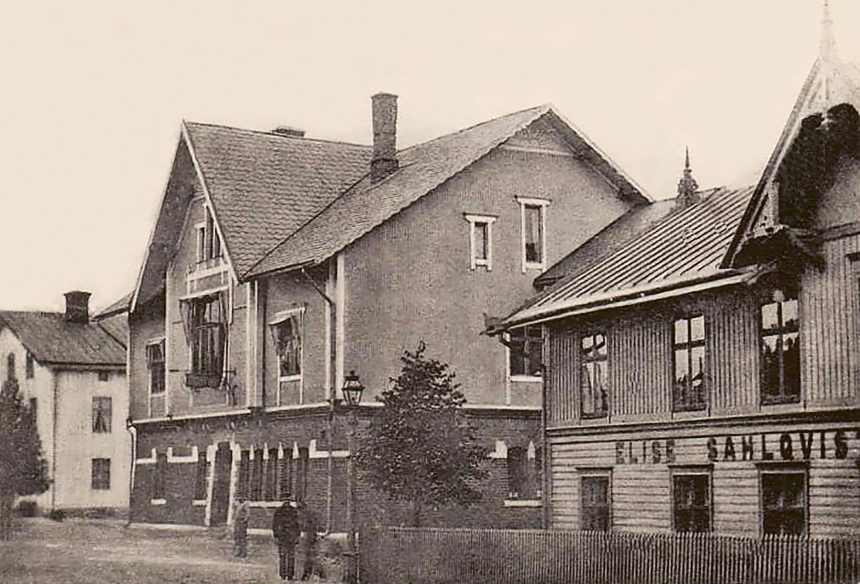
PHOTO: Karin Bergöö Larsson’s friends, 1904.
Karin’s childhood home, the White House, is on the far left. Here, the Bergöö family lived with the children’s governess Anna Morien, grandmother Maja-Stina, and aunt Elise (Lisen) Sahlqvist, who later ran the hat shop on the far right. In the middle stands the Bergöö House from 1889, designed by Ferdinand Boberg, with a shop on the ground floor and living quarters above. The Bergöö House was built only after Karin married Carl Larsson, so Karin never lived there.
Karin Bergöö was born in Örebro in 1859 but grew up in Hallsberg. She showed early artistic talent, which led her to study at the School of Industrial Arts in Stockholm and the Royal Academy of Fine Arts, something uncommon for girls at that time. As a young woman, she traveled to France and became part of the Scandinavian artists’ colony in Grez-sur-Loing. There she met Carl in 1882, and a great love blossomed. Back in Sweden, the family followed Carl’s assignments to Stockholm and Gothenburg. Karin’s time was filled with children and family, and she put her paintbrushes aside.
In 1888, Karin’s father, Adolf Bergöö, donated the small cottage Lilla Hyttnäs to the young family. The house grew with the family’s needs and was expanded in several stages to accommodate both studios and space for everyone. Here, Karin could unleash her creativity, becoming a pioneer in Swedish interior design and textile art. The bold colors that give the home its character were something never seen before.

BY THE KATTEGAT. Watercolor, Carl Larsson, 1887.
Karin and Carl lived for a short period in Varberg. Carl painted Karin in a coastal landscape with Brita on her lap and needlework in her hands. She was an exceptionally hardworking woman, sewing almost all the clothes, even the hats, for herself and the children.
“Oh, Karin, sweet and gentle
Oh, Karin, fair, good, dear
We all have your image
To carry in our hearts”
Karin Larsson died in 1928 and is today considered one of the most influential women in Swedish art and design during the late 19th and early 20th centuries. As a textile artist, furniture designer, and interior architect, she created an entirely new aesthetic for the Swedish home with bright colors, simple forms, and functional design.
Through Carl’s paintings, her aesthetic spread worldwide. She became a pioneer in Swedish design whose ideas live on today. Despite her central role, Karin has long remained in her husband’s shadow. But more and more people now see that “A Home” is just as much her art – without Karin, Carl Larsson’s art would have looked completely different.
Written by Carl on a card on Karin’s Day, August 2, 1894. Karin was 36 years old at the time.
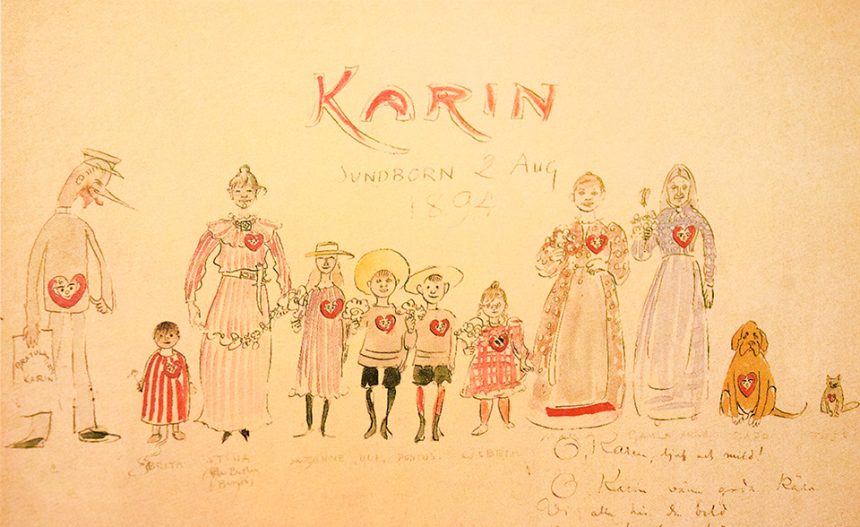
GREETINGS ON KARIN’S DAY, AUGUST 2. Watercolor, ink, and pencil, Carl Larsson, 1894.
GREETINGS ON KARIN’S DAY, AUGUST 2.
Watercolor, ink, and pencil, Carl Larsson, 1894.
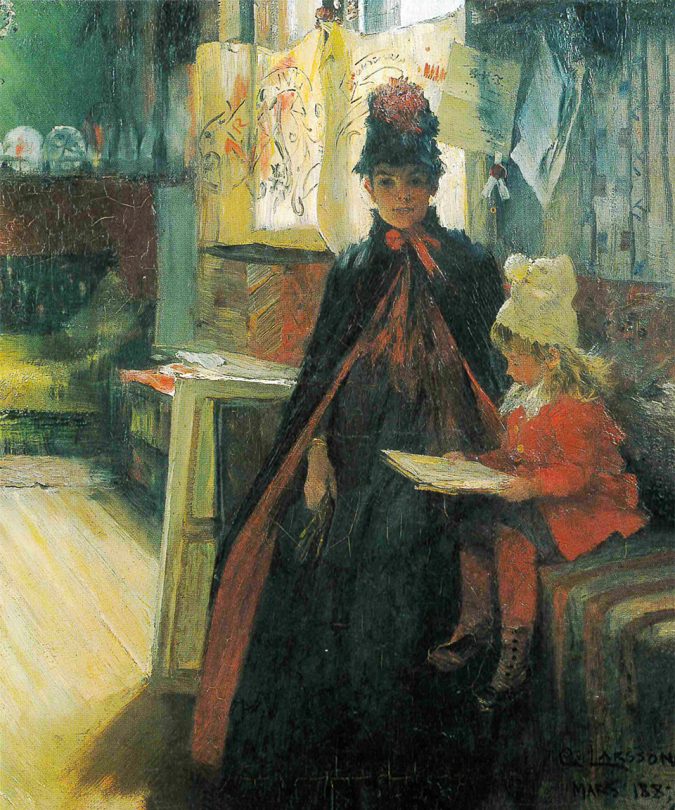
IN VALAND. INTERIOR WITH KARIN AND SUZANNE. Oil, Carl Larsson, 1887.
IN VALAND. INTERIOR WITH KARIN AND SUZANNE.
Oil, Carl Larsson, 1887.

PONTUS ON THE FLOOR. Oil, Carl Larsson, 1890.
During the first period of the Larsson couple’s artistic life, they moved between different countries and cities. The children were born wherever the family lived and worked until they finally settled in Sundborn and Lilla Hyttnäs in 1901. The couple had eight children, six of whom reached adulthood. The eldest was Suzanne, born in 1884 in Grez-sur-Loing, followed by Ulf in 1887 in Gothenburg, Pontus in 1888 in Paris, Lisbeth in 1891 in Stockholm, Brita in 1893 in Marstrand, Mats in 1894 in Stockholm, who tragically died as an infant. Then Kersti was born in 1896 and Esbjörn in 1900, both in Stockholm.
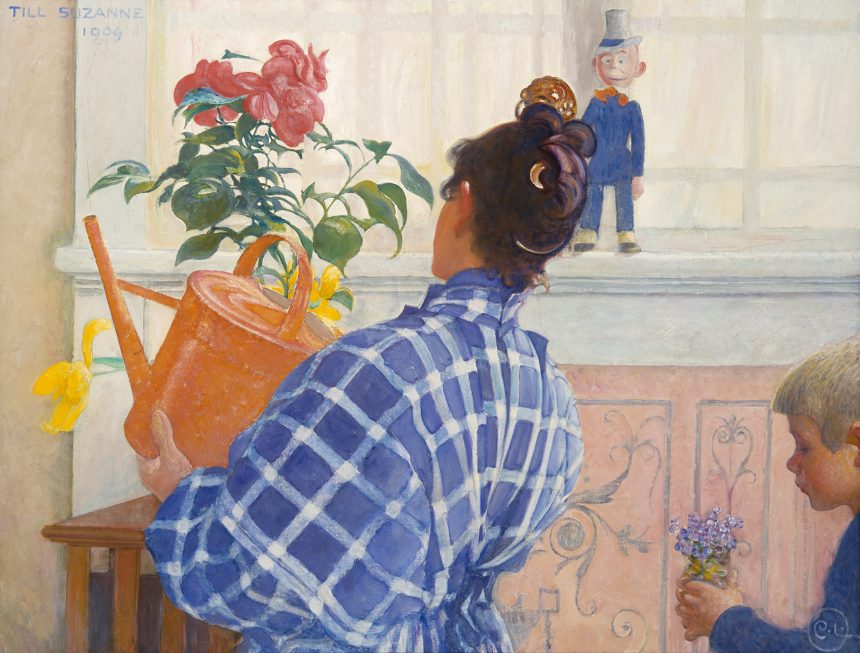
KARIN AND ESBJÖRN. Oil, Carl Larsson, 1909.
Karin and Esbjörn. Their son Esbjörn offers a bouquet of blue anemones to his mother Karin in the family’s home on Blindgatan in Falun. As a mother, she was described by one of her daughters in a 20th-century interview as: “She is not only the dearest mother in the world – she is the bravest, wisest, and most strong-willed – but in an incredibly quiet way. So that most people don’t realize it – that’s what’s so wonderful about mother.” She continued, “It always turned out the way mother wanted, but not so that you noticed it.”

SPRING EVENING. Watercolor, Carl Larsson, 1900.
Karin sewed almost all the clothes for the family – from everyday wear to finer garments and hats. In the painting, daughter Brita wears clothes her mother created with care for both function and aesthetics, made for play and movement.
Karin has a great interest in gardening and cooking. She often uses ingredients from her own garden and enjoys hosting parties and setting beautiful tables. Even today, the current housekeeper arranges imaginative floral displays on the estate. Many of Carl’s paintings depict the family’s meals. The food is rustic and homemade. At the same time, it is modern. Karin is inspired by international cuisine and her time in Grez. Several personal recipes are still used. A tradition that lives on today is that many family members bake “Karin’s gingerbread” in the kitchen at the estate for Christmas.

PHOTO: Carl Larsson-gården, 1905.
Karin and Carl had a remarkably egalitarian relationship for their time. It was clear early on what significance they would have for each other in life – and in art. The home became Karin’s great artistic project. Her sense of color and style were as confident as Carl’s. She also had the final say. When a painting was nearing completion, she would say: “Don’t touch it anymore, Carl – it’s good.” In the picture, Karin sits with one of the children in her arms in the garden at Lilla Hyttnäs. Her place on earth for inspiration and creation.

PHOTO: Henry B. Goodwin, 1924. Nationalmuseum, Cecilia Heisser.
Karin Larsson is a versatile artist and textile artist who played a crucial role in shaping the home Lilla Hyttnäs in Sundborn. Karin’s artistry encompassed textiles, embroidery, weaving, and interior design, which became characteristic of the Swedish home at the turn of the 20th century. Karin was a driving creative force whose artistic vision shaped both the home and Swedish interior style.
Karin’s clothes were groundbreaking, breaking with the corseted fashion of the time. She created loose-fitting garments in linen, wool, and cotton. They were practical, beautiful, and allowed freedom of movement in colorful hues like blue, green, and purple. Small embroideries and woven details brought life to their simplicity.
The striped dress is one of her most famous garments. It is sewn from simple cotton with blue and white stripes. The dress lacks a corset and has practical pockets – created for working, painting, and caring for children. It reflects Karin’s idea of beauty in everyday life. When visitors come to Lilla Hyttnäs, the guides still wear the same model – a living memory of her style.