IN THE CHURCH. Watercolour, Carl Larsson, 1905
In the parish hall of Sundborn Church there is a unique collection of portraits painted by Carl Larsson. The paintings depict local people and are an important part of Sundborn’s cultural heritage. In 1916, Carl donates the collection to the parish in Sundborn in order to preserve the artworks for future generations and to honour the people of the area.
SELF-PORTRAIT. Oil, Carl Larsson, 1916.
Carl Larsson’s self-portrait is part of the collection that Carl donated to the parish of Sundborn in 1916. The portrait collection adorns the parish hall of Sundborn Church.
In Sundborn’s parish hall, twelve portraits painted by Carl Larsson are displayed, depicting people who were involved in the village’s life and development in the early 1900s. Here are the parish’s craftsmen and farm bailiffs, as well as the dean, lay judges and other leading figures – all those Larsson wished to honour. Among them are Dean Pettersson, Lieutenant Colonel Linderdahl, the painter Persson, and the farmer and farm bailiff Forsberg of Sandsberg.
Five portraits painted in 1915 were donated to the parish of Sundborn in May 1916. At the request of others, Larsson painted his self-portrait in 1916, as well as the portraits of the carpenter Arnbom (1915) and the painter Persson (1913). In the spring of 1918, he added a further three portraits of people he believed should be included in a complete collection of “deserving parishioners”.
The portraits show people who held important roles in village society and are both a history lesson and a tribute to friendship and community. “They are all my friends.” Today, the collection is owned by the Municipality of Falun and offers a unique insight into life in Sundborn around the turn of the 20th century.
Open summer 2026: 6 July–31 July, 12:00–16:00. Free admission.
Please note that the parish hall may be closed to visitors during memorial services.
The portraits depict the parish’s craftsmen and leaders who worked for the village’s governance and community life.
Carl Fredrik Pettersson
The Dean, 1905
Carl Oskar Persson
The Painter, 1913
Hans Arnbom
The Carpenter, 1915
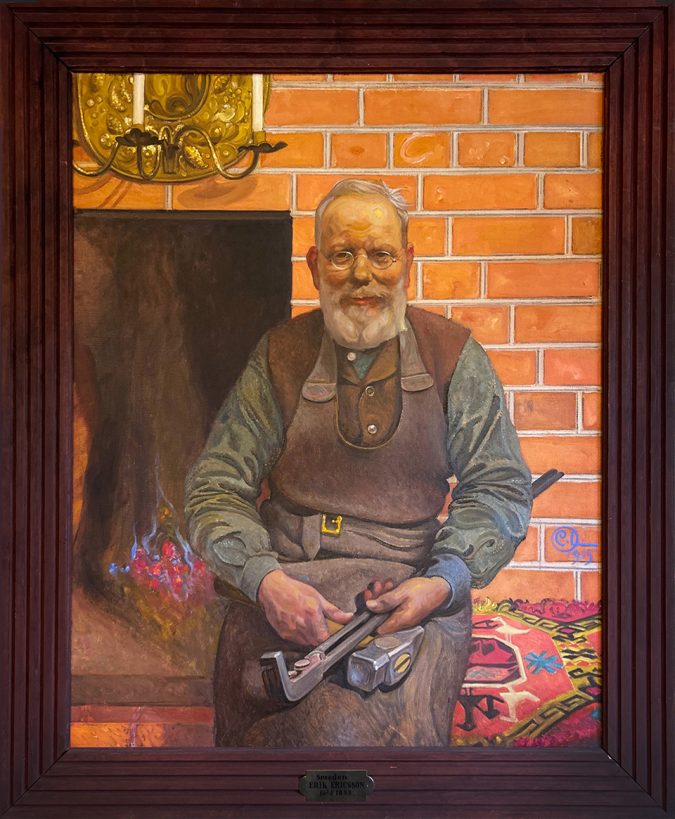
Erik Eriksson
The Blacksmith, 1915
Fredrik Forsberg
The Farmer, Farm Bailiff and Soldier, 1915
Pontus Linderdahl
Chairman of the Municipal Meeting and Lieutenant Colonel, 1915
Daniel Wretling
The Lay Judge and District Constable, 1915
Carl Fredrik Steinholz
Chairman of the Municipal Board, 1915
Carl Larsson
Self-portrait, 1916
Hans Svedberg
The County Constable, 1918
Samuel Söderberg
Member of Parliament, 1918
Gustav Hedström
The Parish Clerk and Schoolteacher, 1918
DEAN C.F. PETTERSSON. Oil, Carl Larsson, 1905.
THE PAINTER CARL OSKAR PERSSON. Oil, Carl Larsson, 1913.
THE CARPENTER HANS ARNBOM. Oil, Carl Larsson, 1915.
THE BLACKSMITH ERIK ERIKSSON. Oil, Carl Larsson, 1915.
THE FARM BAILIFF FREDRIK FORSBERG. Oil, Carl Larsson, 1915.
At the inauguration of Liljevalchs Art Gallery on 1 March 1916, Carl Larsson took part together with Anders Zorn and Bruno Liljefors. There he exhibited the portraits of four craftsmen as well as the lay judges Linderdahl, Steinholz and Wretling. In the exhibition catalogue, the three lay judges are listed as belonging to “the parish of Sundborn”.
Carl Larsson writes:
“We country folk truly need both God, church and priest. We behold God’s wonders at close hand, every day, and we feel wholly dependent on His grace and blessing.
Sundborn Church is a cruciform wooden building from 1755, built on the site where an earlier church building had stood since the early 1600s. The church is beautifully situated by Lake Toftan and is a central part of the area’s history and cultural heritage.
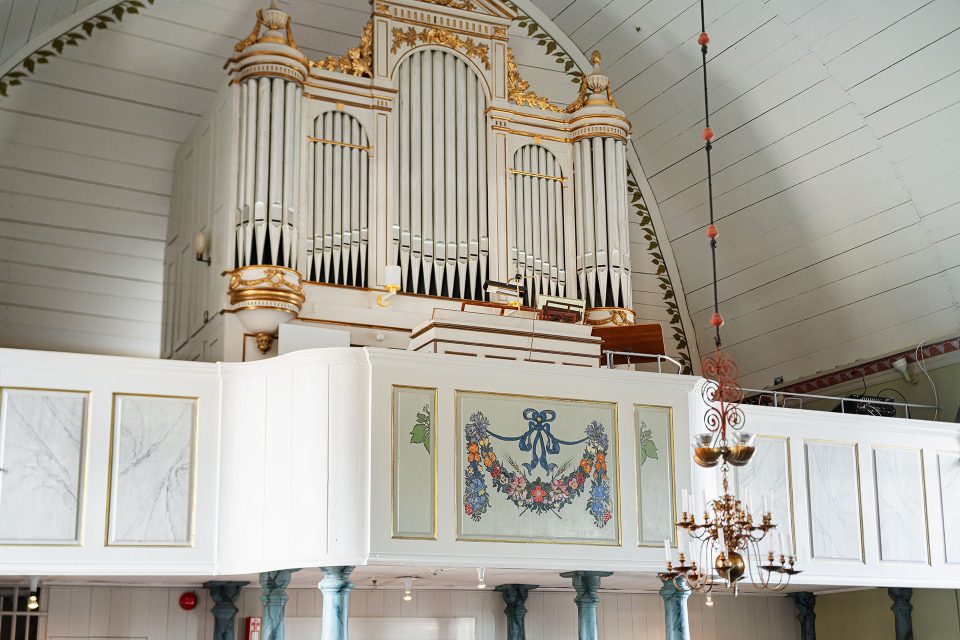
During a major renovation in 1905, Carl Larsson led the interior transformation of the church by colouring and decorating the interior. Prominent features include altar angels, a painting of John the Baptist, and wall decorations in the form of pine shoots and masses of flower garlands. Among the decorative motifs is the so-called “Angel Painting” above the altar.
Carl Larsson is buried in Sundborn Churchyard together with his wife Karin Larsson and other family members. The grave is part of the area’s cultural-historical setting and links the artist’s life, work and sense of belonging in Sundborn.
If the drought lasts too long, we meekly turn to the prayer book, and if everything goes according to our wishes – more or less, for we are never satisfied – then we gladly sing a hymn of praise.
“When our little church was closed for a few weeks for repainting, the whole parish was like a rag – that shows how necessary the church is in the countryside – said Karin.”
SUNDBORN’S OLD CHURCH. Watercolour. Carl Larsson, 1896.
IN SUNDBORN CHURCH. Watercolour. Carl Larsson, 1905.